Whitepaper

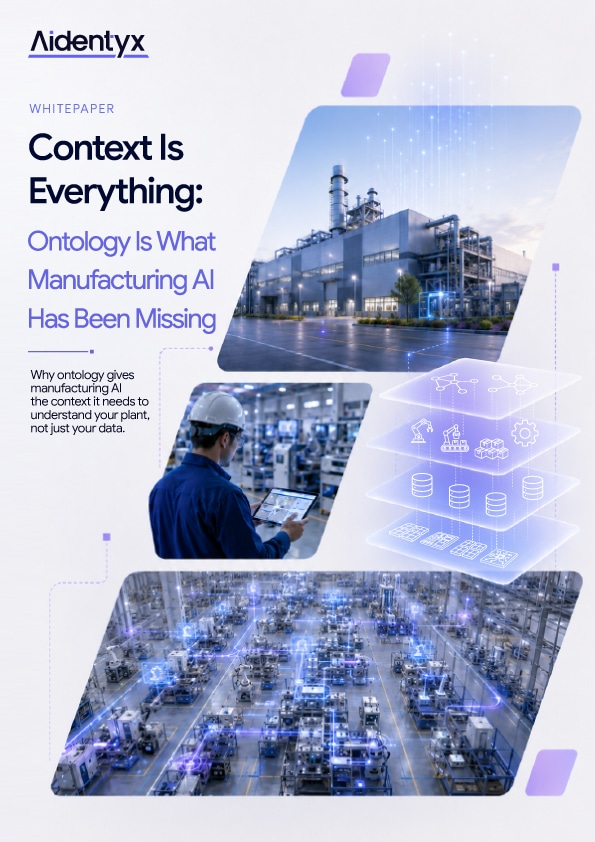
Context Is Everything: Ontology Is What Manufacturing AI Has Been Missing

Discover how manufacturing ontology gives AI the context to connect assets, processes, people, resources, and business outcomes—and reason beyond isolated data points.

  • Connect operational signals to real business impact
  • Scale AI across assets, processes, and teams
  • Move from reactive alerts to context-aware decisions
Get the Whitepaper
Context Is Everything whitepaper about manufacturing ontology and context-aware AI

Inside the White Paper

How Manufacturing Ontology Connects One Event to Business Impact

One event. Two very different outcomes.
Follow a critical motor anomaly to see how ontology connects equipment health, operational resources, production schedules, and business impact.

  • 01

    Go beyond an isolated maintenance alert

  • 02

    Coordinate responses across operations and business teams

  • 03

    Connect technical decisions to production impact

Learn how we handle your information in our Privacy Policy .

The Context Layer

One signal.
A connected view of its impact.

Manufacturing ontology connects an equipment event to the operational context around it—so AI can reason beyond the alert.

Why Manufacturing Ontology Matters

Context turns signals into decisions.

A sensor can identify an event. Manufacturing ontology helps AI understand what that event could mean across equipment, production, people, and business priorities.

  • 01

    Understand operational impact

    Connect equipment conditions to production schedules and business outcomes.

  • 02

    Coordinate action

    Give maintenance, operations, and business teams the same operational context.

  • 03

    Scale with context

    Reuse a shared view of the plant across agents, assets, and new AI use cases.

What is manufacturing ontology?

Manufacturing ontology is a structured representation of the assets, processes, people, materials, work orders, and production activities within an industrial operation. More importantly, it describes how those entities relate to one another. Different equipment names, records, sensor tags, and systems can resolve to the same real-world asset or process. This gives engineers, operators, and AI agents a consistent view of the plant instead of separate, disconnected interpretations.

Why does manufacturing AI need operational context?

An equipment signal can show that vibration, temperature, or pressure is moving outside its expected range. The signal does not explain what the equipment supports, which production order depends on it, whether maintenance resources are available, or how downtime could affect delivery commitments. Operational context connects the technical event to these wider consequences, helping AI support decisions that reflect both engineering conditions and business priorities.

How does ontology help industrial AI scale?

Many industrial AI projects begin with one machine, one dataset, or one narrowly defined use case. When each new project must rebuild the meaning behind plant data and recreate the relationships between systems, expansion becomes slow and inconsistent. A shared ontology gives new applications and AI agents an existing operational foundation. Connected knowledge can be reused across maintenance, production, quality, energy, and other workflows without starting from an isolated dataset every time.

What does the whitepaper explore?

Context Is Everything follows a critical motor anomaly through the broader operation. It shows how the same equipment event can influence maintenance planning, available staffing, production schedules, and business outcomes. The whitepaper explores why connected operational knowledge matters and what changes when AI can reason across the plant rather than respond to isolated data points. Download the whitepaper to see how manufacturing ontology connects technical signals with operational impact and supports more informed action across the enterprise.

PODO Signal

Sign up for PODO Signal

Quarterly Manufacturing AI insights, product updates, and expert content from Aidentyx.

Please leave your work email address here.

Marketing Permissions

Aidentyx will use the information you provide to send newsletters, product updates, event updates, and other relevant communications.