
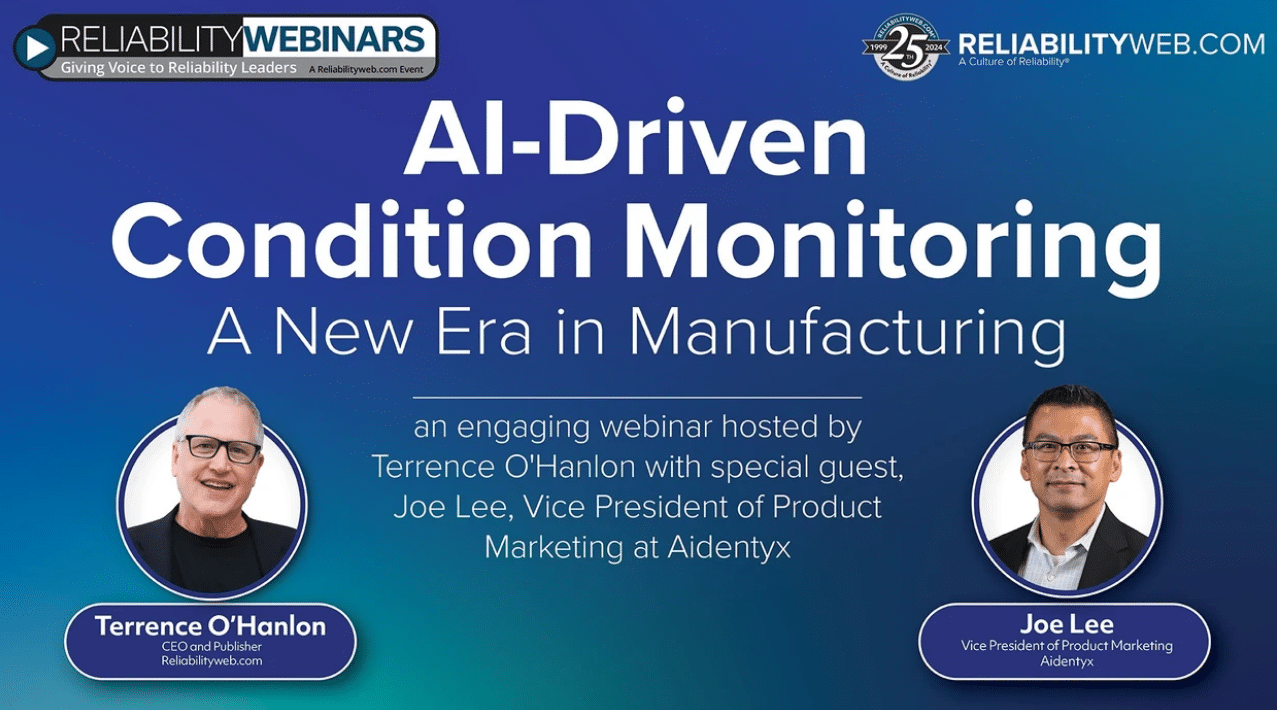
AI-Driven Condition Monitoring: A New Era in Manufacturing
AI-driven condition monitoring is changing how manufacturing teams understand equipment health and respond to emerging problems. By combining continuous machine data with AI-based analytics, maintenance and reliability teams can identify abnormal behavior earlier, investigate potential faults, and make more informed decisions before equipment issues become unplanned downtime.
This webinar explores how AI can strengthen condition monitoring, predictive maintenance, fault detection, and manufacturing reliability—and how teams can move beyond isolated equipment alerts toward more actionable operational intelligence.
Watch the full webinar below.
What Is AI-Driven Condition Monitoring?
AI-driven condition monitoring uses equipment and operational data together with artificial intelligence to identify patterns, anomalies, and changes in machine behavior that may indicate an emerging issue.
Traditional condition monitoring often depends on individual sensor thresholds, periodic inspections, or manual analysis of trends. Those methods remain valuable, but AI can add another layer by evaluating multiple signals and operating conditions together and continuously looking for behavior that differs from an asset’s expected performance.
The goal is not simply to generate more alerts. It is to help engineers understand which changes matter, investigate them faster, and make better-informed maintenance decisions.
Moving Beyond Equipment Alerts
An alert is only the beginning of the maintenance workflow.
After abnormal equipment behavior is detected, an engineer may still need to determine what changed, review historical performance, compare related signals, identify possible causes, locate maintenance procedures, understand operational impact, and decide what action should follow.
When these steps depend on manual searches across disconnected systems, the time between detection and action can grow significantly.
AI-driven condition monitoring can help reduce that gap by bringing relevant equipment behavior and operational information together so reliability teams can move more efficiently from signal to diagnosis to action.
From Condition Monitoring to Predictive Maintenance
Condition monitoring helps teams understand what is happening to an asset now. Predictive maintenance extends that understanding by identifying patterns that may indicate degradation or an increased likelihood of future failure.
AI can strengthen this process by analyzing real-time and historical equipment data together, recognizing recurring patterns, and identifying changes that might be difficult to detect through individual alarms or manual trend analysis alone.
This gives maintenance teams more time to investigate developing issues, prioritize resources, and plan intervention before a problem becomes a production interruption.
How AI Can Strengthen Machine Health Monitoring
AI can support condition monitoring across a range of equipment and manufacturing environments by helping teams:
- Detect abnormal operating patterns earlier
- Evaluate multiple equipment signals together
- Identify potential fault patterns and degradation
- Compare current behavior with historical equipment performance
- Support predictive maintenance decisions
- Prioritize which equipment conditions require attention
- Reduce the manual analysis required between an alert and a maintenance response
The value comes from connecting equipment data with enough operational context to understand not only that something changed, but why that change may matter.
Connecting Condition Monitoring to Manufacturing Reliability
Better equipment visibility can have an impact far beyond the individual asset.
Earlier detection and faster investigation can help manufacturers reduce unplanned downtime, improve equipment availability, prioritize maintenance resources, and give reliability teams more time to respond to developing problems.
Condition monitoring therefore becomes most valuable when it is connected to the broader maintenance and production workflow.
Instead of ending with a dashboard, alarm, or prediction, the information can help answer the questions engineers actually need to resolve:
What changed? Why did it happen? What is the operational impact? What should we do next?
From Detection to Action
The PODO® AI Framework connects shared plant context, reusable manufacturing AI skills, purpose-built applications, and AI Engineering Agents so operational intelligence can move beyond detection.
For maintenance and reliability teams, this means equipment signals can be connected with maintenance history, operating conditions, engineering knowledge, and related plant information to support diagnosis and the next appropriate action.
AI-powered asset performance management can extend condition monitoring beyond identifying abnormal behavior by helping teams understand equipment health in context and prioritize maintenance decisions.
AI Engineering Agents can then work across that shared operational context to help engineers investigate issues, gather relevant evidence, and coordinate the next step while keeping people accountable for the final decision.
Building on the Fundamentals
AI does not replace the fundamentals of maintenance and reliability. Effective condition monitoring still depends on useful equipment data, sound engineering practices, appropriate instrumentation, and people who understand the assets and processes they operate.
AI becomes most useful when it reduces the work required to connect those fundamentals—bringing signals, history, context, and engineering knowledge together so teams can spend less time searching for information and more time deciding what to do with it.
The opportunity is not simply smarter monitoring.
It is a shorter, more connected path from equipment condition to informed action.