
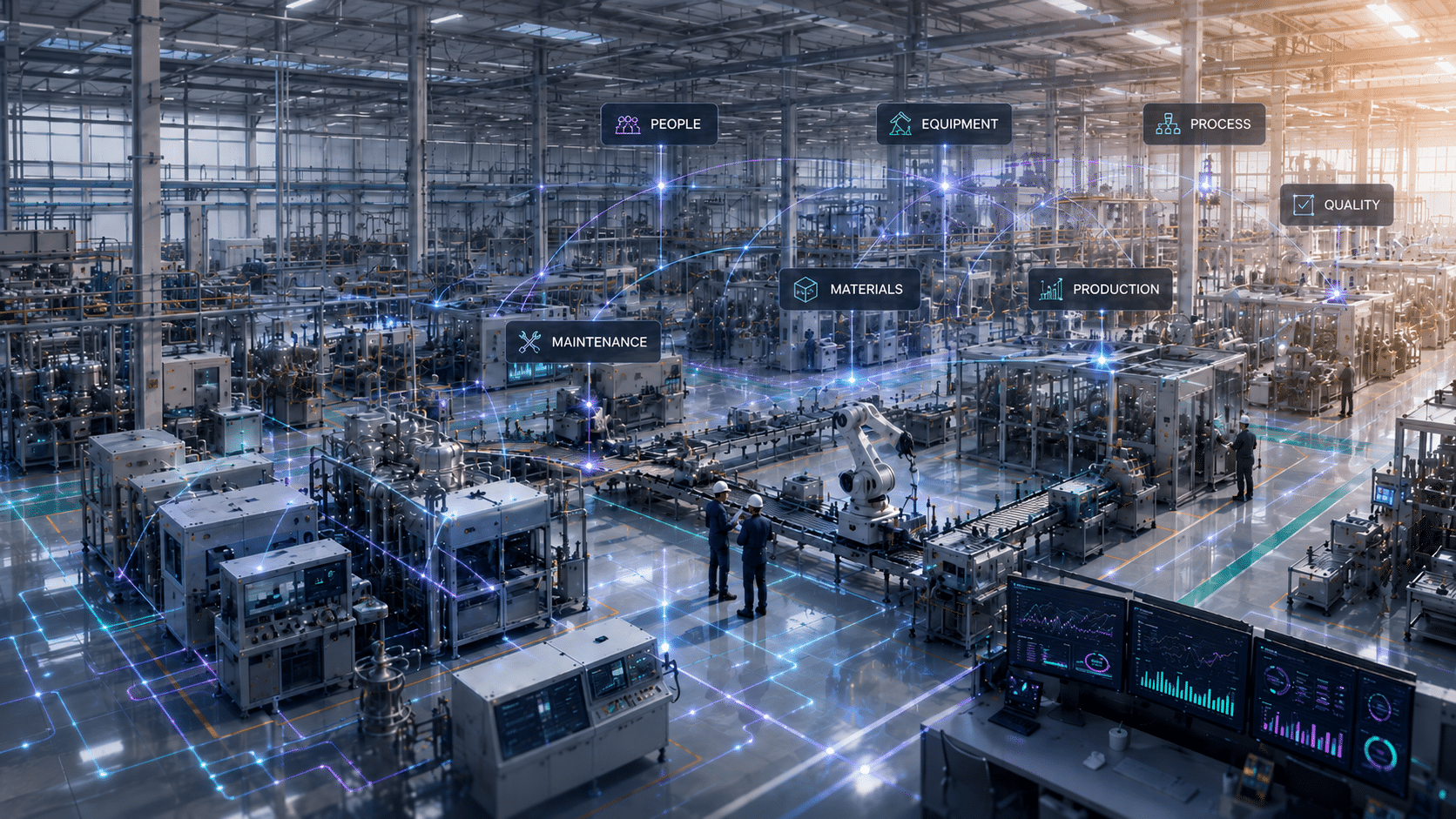
The factory is connected. So are its problems.
Manufacturing problems rarely stay inside one system, team, or domain. Deep specialization makes plants work. Shared operational context helps engineers and manufacturing AI see how equipment, process, quality, maintenance, materials, production, and people connect around the same issue.
Deep expertise is a strength. Bounded context is the limitation.
Equipment engineers learn to read equipment behavior.
Process engineers understand recipes, parameters, and operating conditions.
Quality teams know variation and release criteria. Maintenance teams know asset history.
Production teams know schedules and commitments.
That depth is how good plants run.
The challenge begins when an operational change no longer belongs to only one of those views.
A condition in one area can change the meaning of data somewhere else.
The plant experiences those relationships continuously, even when its systems and organizational boundaries do not.
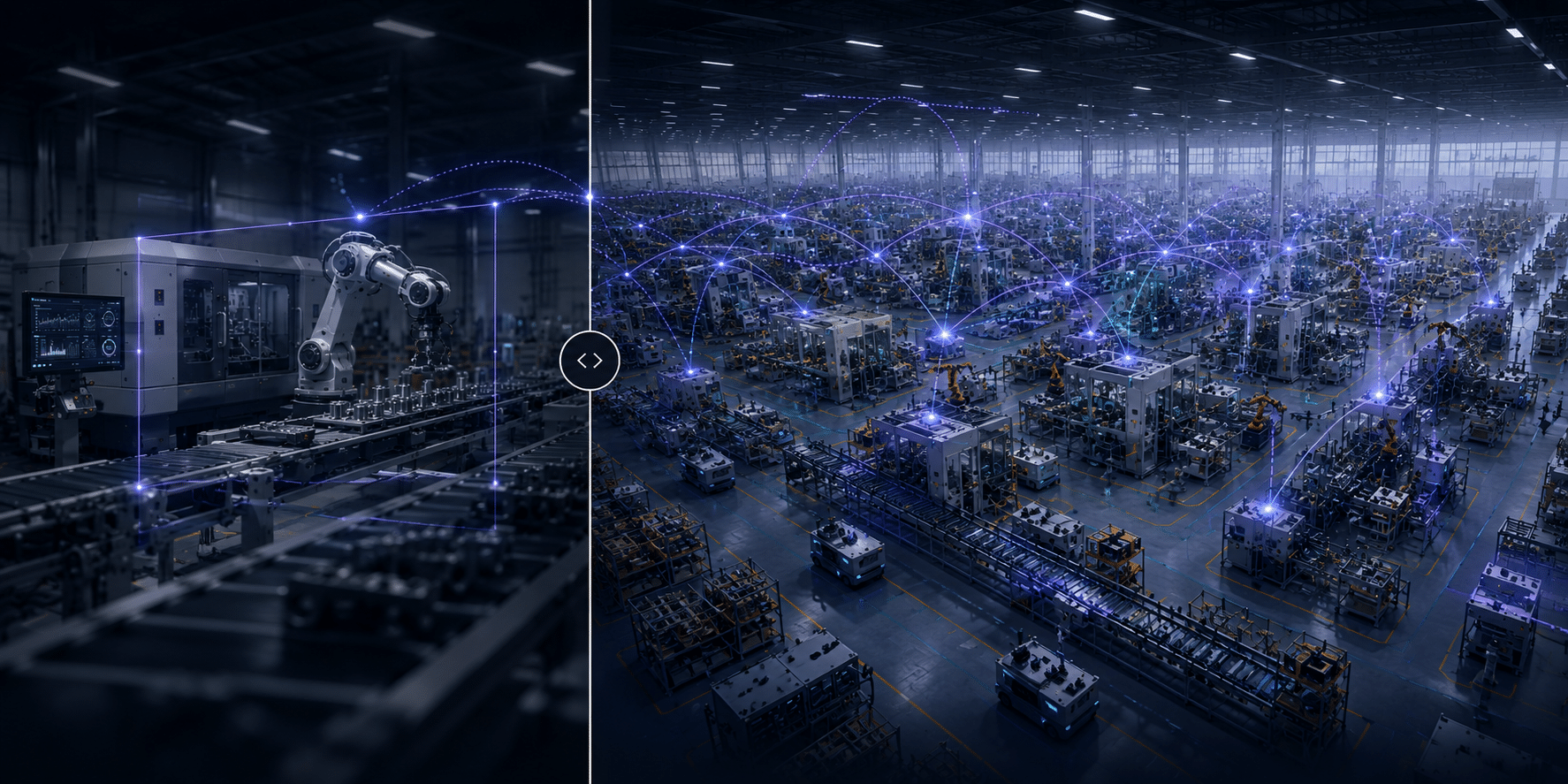
in depth.
is connected to.
A problem rarely ends where it begins.
A change in equipment behavior may affect a process condition. A process change may surface later in quality.
Maintenance timing can alter production availability. Materials, staffing, schedules, and business commitments can all change the consequence of the same local event.
The important point is not that every event affects everything.
It is that the boundaries of the problem are not necessarily the boundaries of the system that detected it.
That changes the question engineers and manufacturing AI need to answer.
Detecting what changed is valuable. Understanding what that change is connected to is what reveals its operational meaning.
The same change can carry different meaning across the factory.
Each domain contributes a valid piece of context.
Shared operational context comes from preserving the relationships between those pieces so the wider impact can be understood without flattening domain expertise.
Illustrative relationships. The relevant context changes with the problem, process, and operating environment.
More data does not automatically create more context.
Manufacturing information is often already present across historians, MES, CMMS, ERP, quality systems, engineering records, work orders, and operator knowledge. The harder problem is preserving what those records refer to and how they relate to the same physical operation.
The same asset can carry different names or IDs across systems. A batch can be connected to a recipe, line, shift, material lot, quality result, and maintenance event.
Without those relationships, AI can retrieve more information while still missing why that information matters together.
Shared operational context changes the task from assembling isolated records to interpreting connected evidence.
A shared manufacturing model preserves those relationships, while a manufacturing ontology makes them computable so people and AI can reason over the same operational picture.
Shared context should amplify experts, not flatten expertise.
Plantwide context does not require an equipment engineer to become a process, quality, maintenance, and production expert.
It gives that engineer a wider field of view while keeping domain judgment where it belongs.
The same is true for manufacturing AI. The goal is not to make one model pretend to know every domain equally well.
It is to give AI enough connected context to identify which relationships matter, surface the right evidence, and help the right people follow the problem beyond the boundary where it first appeared.
Every expert sees a part of the factory. The problem sees all of it.
Manufacturing AI becomes more useful when it can connect those views without erasing the expertise behind them.