
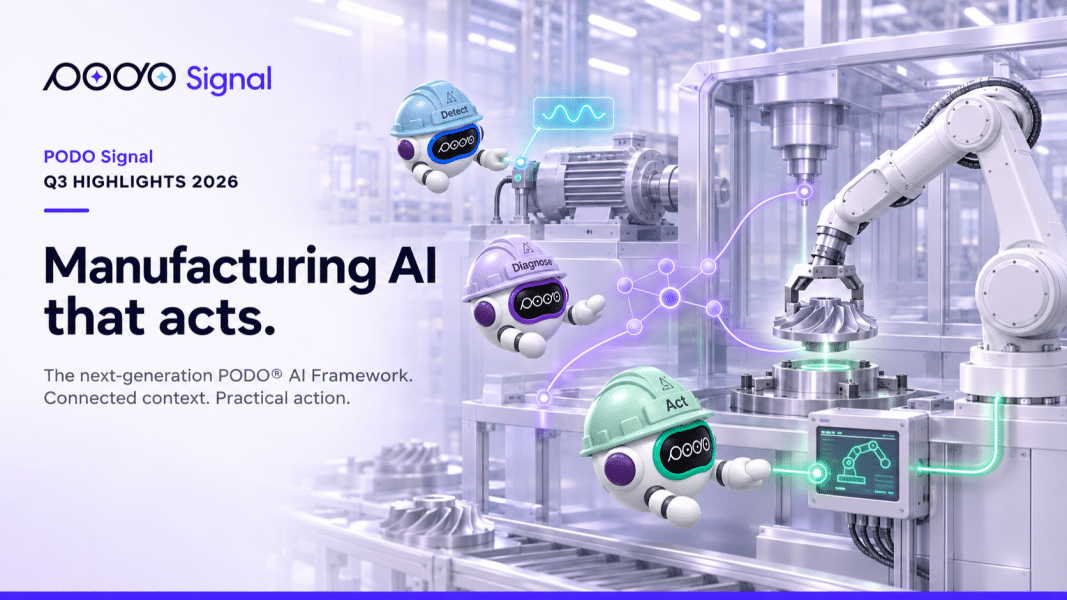
How Aidentyx is connecting manufacturing knowledge, engineering tools, and AI agents to support informed decisions and coordinated action.

Manufacturing AI becomes useful when teams can connect what changed with what should happen next.
An equipment signal may point to a developing issue. Understanding its significance requires a wider view: the process it supports, the production priorities around it, the resources available, and the people responsible for the next decision.
This edition brings together our framework launch, resources on putting manufacturing AI into practice, and conversations from SMRP and SEMICON West.

The next generation is here.
Aidentyx has officially launched the next-generation PODO® AI Framework, connecting manufacturing knowledge, specialized tools, purpose-built applications, and collaboration between engineers and AI agents.
Four connected layers support this approach: Knowledge provides a shared manufacturing context; Skills brings analytics and engineering methods; Applications combines them for specific operational needs; and Collaboration gives engineers and AI agents a shared space to review evidence and coordinate next steps.
Together, these layers support a connected workflow: detect a change, diagnose its likely causes and operational implications, and determine an appropriate action with human review.

Getting Manufacturing AI Right on the Modern Plant Floor
How do the building blocks of manufacturing AI work together in practice? Our white paper examines the roles of Knowledge, Skills, Applications, and Collaboration in supporting engineering work.
A useful investigation needs relevant evidence, appropriate analytical tools, and a way for people to assess the findings within their operating environment. Explore how these elements support the path from detection to diagnosis and action.

Industrial AI Goes Beyond Detection
What happens after an equipment issue is detected? In Reliability AI Labs, the team explores how the PODO® AI Framework connects equipment issues to operational decisions—understanding a signal within the operation around it so teams can evaluate what it means and decide how to respond.

SMRP 2026: Context for the next decision
At SMRP, we explored how operational context can help maintenance and reliability teams evaluate equipment issues and determine the next step.
Joe Lee’s Innovation Lab session examined how an equipment condition takes on different significance depending on the production situation and maintenance resources around it.
A practical takeaway: begin with a focused decision, connect the information needed to support it, and define where engineers review the proposed response.

SEMICON West 2026: Give AI the context to act
As a Premier Pavilion Sponsor of the Smart Manufacturing Pavilion, Aidentyx shared how connected fab knowledge can support semiconductor engineering decisions.
Our booth illustrated a Detect, Diagnose, and Act workflow, connecting wafer patterns and equipment signals with process records, chamber history, recipe information, and maintenance knowledge.
The conversations explored how this shared context could fit into existing engineering workflows, with proposed actions reviewed before authorized work proceeds.

Context Is Everything: Ontology Is What Manufacturing AI Has Been Missing
An investigation becomes more useful when teams can see how an equipment issue relates to the wider plant. This white paper explores how manufacturing ontology connects equipment, resources, and production priorities—helping engineers and AI agents interpret evidence within the same operational picture.

A new look. More to explore.
Our updated website brings together the PODO® AI Framework, AI Engineering Agents, white papers, and event stories. Explore how the framework supports asset performance and energy management, and revisit the ideas and conversations featured in this edition.

Connected context. Practical action.
The next step for manufacturing AI is grounded in the decisions engineers make every day. Which evidence is relevant? What does it mean for the operation? What response is appropriate, and who needs to review it?
Connecting knowledge, tools, and people around those questions is central to our work with the PODO® AI Framework.
Thank you to everyone who shared their experience and questions with us this season. We look forward to continuing the conversation.